Designing for Your Grandma: Why Your Most Advanced Design Needs to Meet Your Least Tech-Savvy User

Updated: Jun 12
When we talk about User Experience (UX), we tend to imagine the "perfect user": someone tech-savvy and fast, who navigates through complex features with their eyes closed. In reality, however, the world’s most successful digital products weren’t built for the most sophisticated user. They were built on one of the industry’s oldest benchmarks: "The Grandma Test."
The phrase "design it like your grandma is going to use it" originated in the early days of personal computing, when the goal was to make complex systems accessible to the general public. Of course, no modern designer is literally referring to their own grandmother. Many of them are scrolling TikTok and sending mobile payments just like the rest of us. Using the word "grandma" is simply a mental shortcut, a metaphor for the ultimate extreme: the non-technical user who approaches a product with zero prior training.
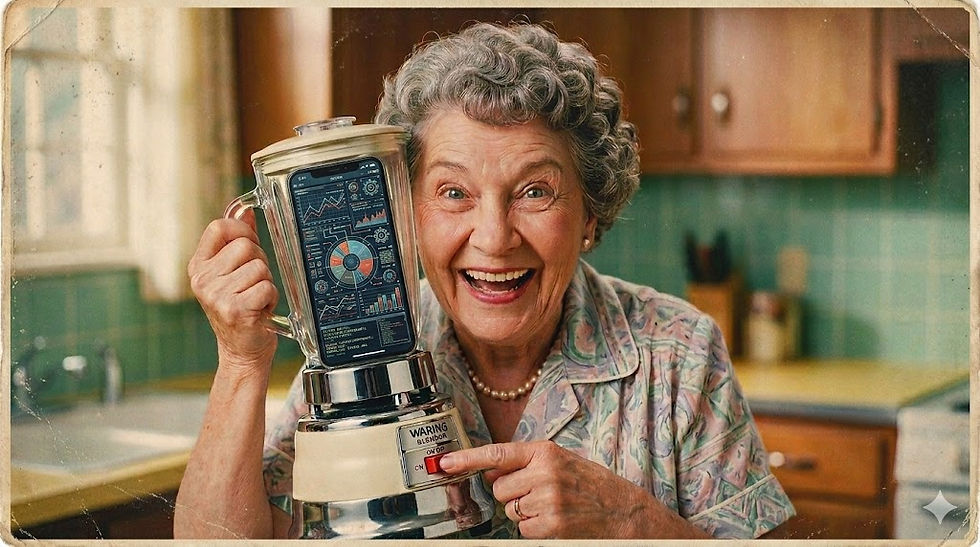
In the UX world, this approach is deeply rooted in a methodology called Extreme User Design. When we design solely for the mainstream, we tend to build predictable, linear solutions. But when we shift our gaze to the edges, to the tech-anxious or the easily frustrated user, we are forced to radically simplify the underlying complexity.
At this point, the design community often splits into two viewpoints.
On one hand, critics argue that foundational UX principles dictate we must design strictly for the actual Target Audience. From this perspective, if you are building a highly complex cybersecurity dashboard for data analysts, trying to force it to pass "The Grandma Test" risks handicapping the product. Over-simplifying can end up hiding advanced features and slowing down actual Power Users. Some even argue the phrase reinforces patronizing stereotypes.
On the other hand, the philosophy of Inclusive Design proves that radical simplicity is not a compromise, it is a performance upgrade for everyone. The moment you strip away unnecessary cognitive load from an interface, you create an experience that is not just accessible, but effortless. If the most extreme user can complete a task without friction, then your power users will fly through that same system at lightning speed with fewer errors.
Ultimately, designing "for grandma" isn't about assuming your user is incompetent, it’s about reframing how we define intuition. Pre-digital generations navigated the physical world flawlessly, through kitchens and city streets, using habits and real-world logic. Designing this way means translating those natural, real-world mental models into the digital space.
The next time you sit down to crack a complex screen, don't just ask how an expert will decipher it. Ask whether your interface speaks a natural, human language that respects cognitive boundaries. Because ultimately, great design isn't about making the user feel smart, it's about making the user feel like the product itself is just smart.

Comments