Your clients know what they want, but do they know what they need?

Our clients have a natural tendency to tell us exactly what they want. The problem is, human beings are notoriously bad at knowing what they actually need. They come to the table with a list of requirements, sometimes even a fully fleshed-out sketch, and expect us to execute.

But our role as designers and strategists isn't to be mere "production hands." We are here to solve complex human problems. To do that, we bring an entire toolkit, experience, and a holistic view, one that doesn't just listen to the immediate request, but cracks open what the client, the user, and the business truly need. Our goal is to ensure that a localized solution on one screen doesn't fix a temporary issue only to break the entire experience somewhere else down the line.
It is impossible to talk about this gap without invoking the most famous quote in the product world, attributed to Henry Ford: "If I had asked people what they wanted, they would have said faster horses" (though to be honest, historians aren't entirely sure he ever actually said it, it still illustrates the point perfectly).
This doesn't mean our clients don't know anything. Quite the opposite. They live and breathe the challenge every single day, and our design is ultimately there to serve them. The desire they express, that "faster horse", is simply an indication of one possible solution, pulled from the world of concepts they already know.
This is exactly where we come in. Instead of taking their proposed solution at face value, our most powerful tool is asking one simple question: "Why?".
The moment you ask "Why?", the user stops inventing solutions and starts pointing out their actual, raw pain point. It also opens up the perfect opportunity to ask them for a concrete example from their personal experience. This shift, moving from an abstract wish to a real story from the field, allows us to ground our design in solid data and uncover much broader scenarios.
The Tree Swing Metaphor: A 50-Year-Old Lesson
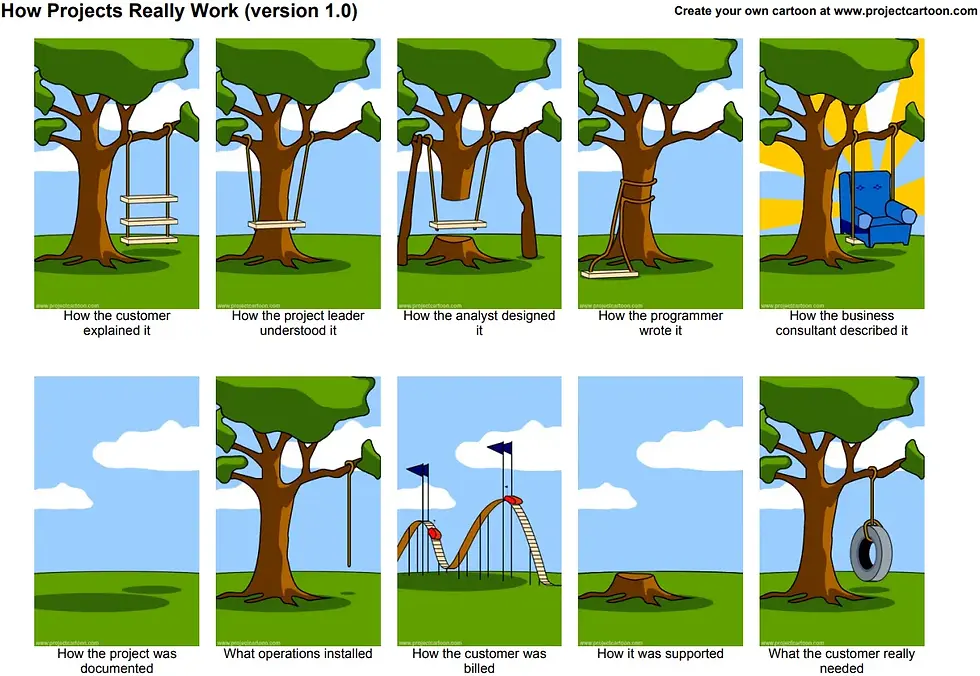
You’ve probably seen the famous "Tree Swing" cartoon. This timeless graphical metaphor has been circulating in corporate offices since at least the late 1960s to illustrate the ultimate communication pitfalls in the division of labor. Its earliest documented print appeared in a University of London computer center newsletter back in March 1973, and it has been used ever since to highlight the flaws of siloed departments.
The cartoon brilliantly charts how a simple request gets lost in translation: Marketing describes a luxury sofa, Engineering designs a structural paradox, and Operations installs a single rope. But the punchline is always the final panel: "What the customer actually wanted" (a simple, classic tire swing).
The Cost of Ignoring Real Client Needs
In our industry, an unbelievable amount of money and precious time is wasted simply because teams rush into development based on what clients say they want. Millions are spent building hyper-complex features that end up completely ignored, all because nobody paused to uncover the true needs of the actual end-users.
This piece of corporate folklore survives because it captures a fundamental truth: clients often visually over-complicate a solution, while the actual answer is far simpler, rooted in an unarticulated core need.
To see how this gap plays out in the real world, and how we bridge it through deep UX strategy, let’s look at a recent case study.
A Quick Case Study: Turning a Feature "Want" into a Product "Need"
During the design phase of a complex system, the project manager on the client's side came to me with a highly specific requirement: to significantly enlarge an image displaying serial numbers within the interface. These numbers were automatically generated and displayed to users as an image file.
The design team hit a wall. It was obvious to us that blowing up this image would ruin the visual hierarchy and break the delicate structure of the screen. The team asked me to step into a call with the project manager to, in simple terms, talk him out of it.
I gave him a call.
But instead of arguing about font sizes or composition, I asked him: "Why?".
He answered immediately: "Our users need this number so they can input it into other internal enterprise systems, or into other forms within this system."
In that exact moment, everything became clear. Enlarging the image was just the "want", a limited workaround he imagined to help users who were struggling to read the numbers. His answer exposed the true need: users needed to pass this data along.
Once we translated the "want" into a "need," we were able to propose much smarter, high-impact solutions without compromising the visual design:
The Immediate Fix: We turned the numbers into live text (instead of an image) and added a quick "Copy to clipboard" button.
The Product Upgrade: We automatically mapped and pre-filled that number into the relevant fields later in the workflow, based on the specific project.
The Strategic Play: We recommended building an API integration between the systems to achieve full automation, meaning the user wouldn't have to manually copy or type anything at all.
If we had listened only to what the client "wanted," we would have ended up with an ugly interface and a giant, blurry image. Because we focused on what they "needed," we delivered enterprise-level automation.
The Bottom Line
Humans might not be great at knowing what they need, but your clients and users are absolutely the people you must talk to. Their natural tendency to ask for what they want can easily be converted into a golden opportunity to understand what they actually need, while still keeping that original "want" in your back pocket as one potential solution to test later.
What truly matters is deeply understanding your users and learning what drives them: what challenges they face along the way, and what thoughts and emotions accompany them throughout their user journey.
Most importantly, don't forget the magic word. Always ask why. Ask it even when you think you already know the answer. We often fall prey to mistaken biases and preconceptions, and more often than not, the real answer will surprise you and reveal perspectives you hadn't even considered.
Your clients bring you the most valuable raw material of all, the real pain from the field. Our job isn't to draw the solution they already imagined, but to translate their pain into what they truly need, and surprise them with solutions they didn't have the tools or capability to reach on their own.
Comments